


Leicester experts investigate ways scientists can safely collect extra-terrestrial samples
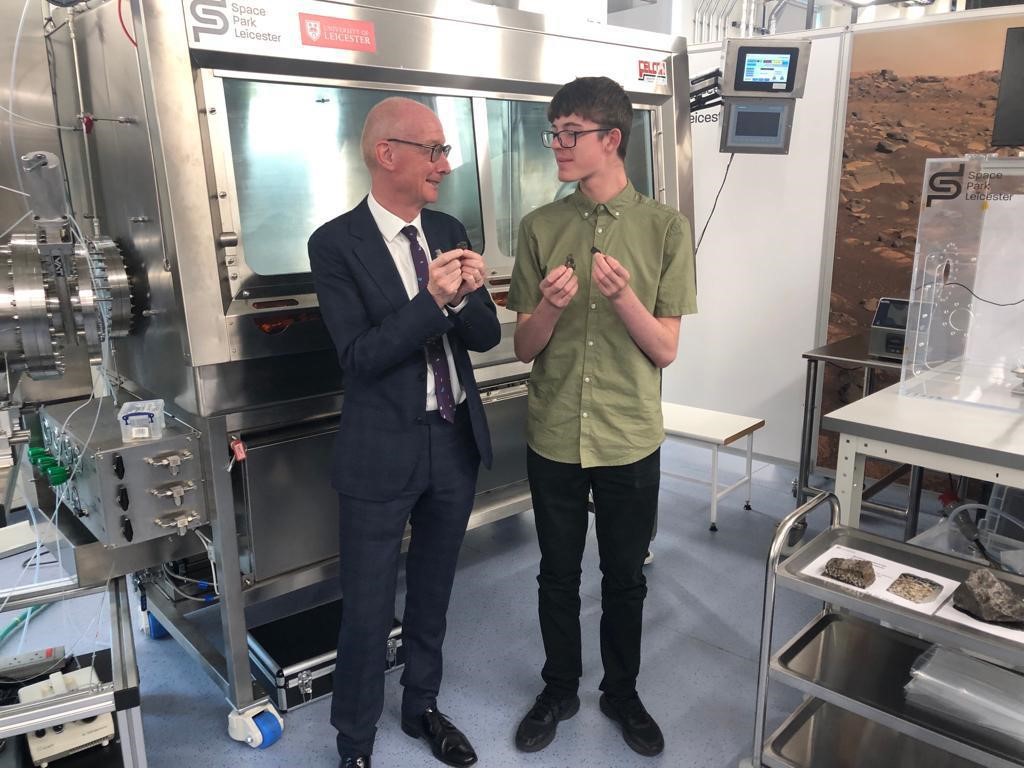
A Leicester team has revealed how technology it is working on is seeking to address the technical challenges facing scientists who want to safely collect extra-terrestrial materials.
Initially developed to support a Mars Sample Return mission, a team at Space Park Leicester and the University of Leicester, has been designing and building a Double Walled Isolator (DWI) – an ultra-clean miniature laboratory that can safely store and analyse extra-terrestrial materials.
Storing and handling rock samples safely is an important aspect of planetary protection because while the rocks could help us search for signatures of life, an organism considered to be extra-terrestrial must be kept isolated from our terrestrial environment.
Last week the Leicester team and its partners published a new paper called ‘Isolator/glovebox technical challenges for the curation of samples returned from Mars’ in the journal Philosophical Transactions of the Royal Society A.
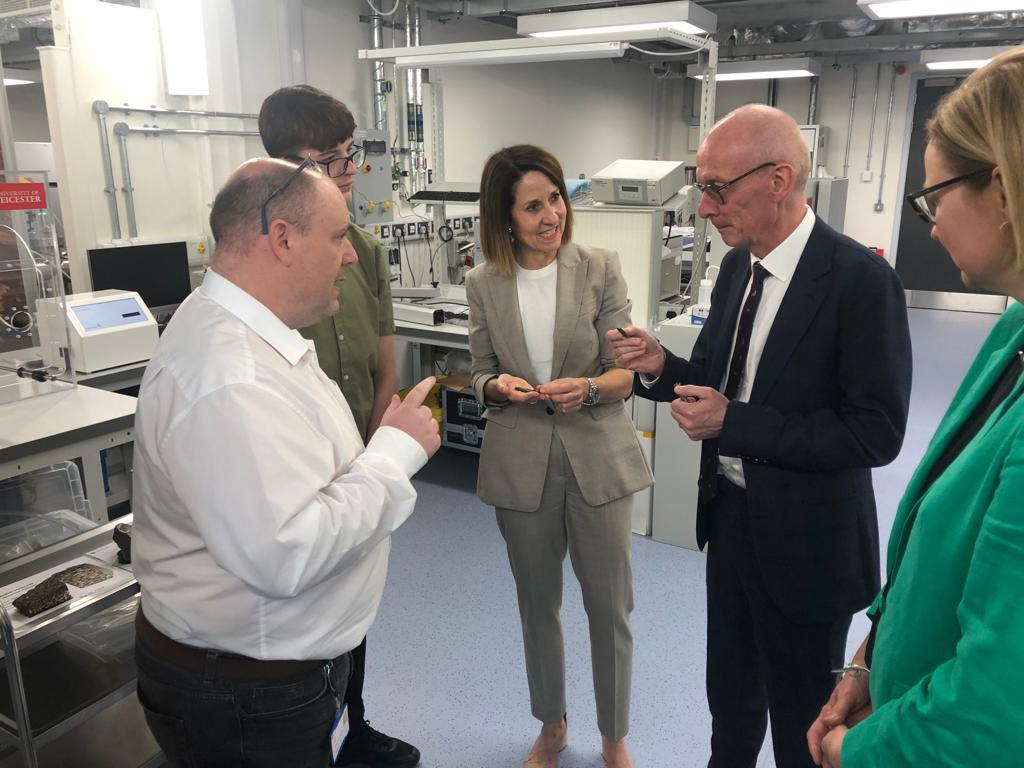
Lead author John Holt, of Space Park Leicester and the University of Leicester’s School of Physics and Astronomy, said:
“We have been designing and building a DWI to safely store and analyse extra-terrestrial materials, including samples from a Mars mission.

“Whatever happens with Mars Sample Return our DWI technology will be beneficial for other countries attempting a similar return mission requiring planetary protection technology or for supporting lunar sample return due to the ultra-clean nature of the DWI system that would protect samples from terrestrial contamination.”
When certain samples are returned to Earth, they are initially stored in a specialised high-containment sample receiving facility, using isolators that meet or exceed the containment standards of a Class III biosafety cabinet.
A key challenge in designing such a facility is integrating biological containment with ultra-clean cabinet operations and robotics for curation. A DWI concept is often discussed as a containment solution to this challenge.
John said: “DWI’s multi-barrier technology enables the safe handling, movement, analysis and curation of precious samples – ranging in size from a single sample rock core to a dust particle – that need to be kept pristine. It’s the really small, microscopic samples that are an interesting challenge.”
“The DWI is a specialised approach to high containment engineering where two separate walls are implemented in a manner that forms a double barrier to isolate the internal from the external lab environment. In addition, the interstitial space between the walls may be used to provide pressure gradients to collectively provide a tertiary containment barrier at critical interfaces.
“The DWI breadboard model developed in the UK serves as a foundational model to inform the next design iteration of a DWI or a similar system.
“The Space Park Leicester team is working with the UK Space Agency to identify a pathway forward to exploit this unique British technology.”
Matthew Cook, Head of Space Exploration at the UK Space Agency, said:

“The Double Walled Isolator technology developed by Space Park Leicester should be a core part of any future Mars Sample Return mission, safeguarding the results of such a mission so they can be studied and protected at the highest possible standards. The technology isn’t just for Mars Sample Return; it could support the analysis of any extra-terrestrial materials and many non-space containment purposes as well – it’s a great example of how space exploration can lead to real-world benefits outside the sector and across the UK economy.”
To read the Leicester team’s paper in full, follow this link.
To explore Space Park Leicester partnerships, missions, residents, facilities, training programmes and innovation products, visit space-park.co.uk or to learn more about the University of Leicester visit le.ac.uk/.
Main image: Pat McFadden MP, Secretary of State for Work and Pensions in 2023 at Space Park Leicester in front of the Double Walled Isolator (DWI)