


Space Park Perspectives
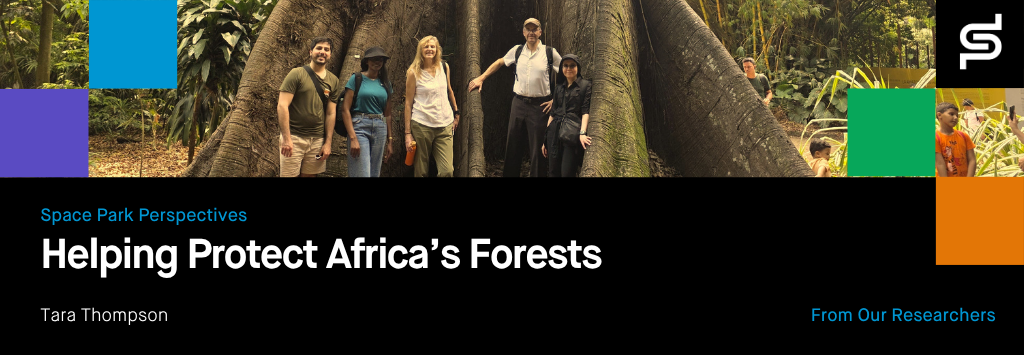
This Earth Day, we’re celebrating the people and projects turning environmental science into real-world impact. Professor Heiko Balzter and Dr Nezha Acil from the National Centre for Earth Observation at the University of Leicester, are leading pioneering work to help protect Africa’s forests using Earth Observation technology and machine learning.
A Wake‑Up Call from Space
Africa’s forests have long played a vital role in keeping our planet healthy by absorbing carbon dioxide from the atmosphere. But recent research led by the University of Leicester shows that these forests have undergone a dramatic shift.
Using advanced satellite data, LiDAR technology, and thousands of ground measurements, scientists discovered that Africa’s forests have moved from being a carbon sink to a carbon source since around 2010.
This means that instead of absorbing more carbon than they release, the continent’s forests are now emitting more carbon than they store—largely due to deforestation and forest degradation, especially in the Congo Basin, Madagascar, and parts of West Africa.
Professor Balzter calls this a “critical wake-up call for global climate policy”, reminding us that if we want to stay within the Paris Agreement’s 2°C warming limit, urgent action is needed on deforestation.
Turning Data into Action: Supporting Forest Governance in Kenya
While their large-scale continental research is crucial, Leicester’s scientists are also making an equally important impact on the ground.
One standout success is Forest Alert—a near real-time deforestation alert system developed in partnership with the Kenya Forest Service.
Forest Alert:
- Sends rapid alerts to mobile phones when new deforestation is detected,
- Uses 10 metre resolution satellite imagery to spot even small-scale logging,
- Combines cloud computing, mobile technology, and community participation,
- Helps forest rangers and communities respond quickly to illegal logging.
This award-winning system is already being rolled out across Kenya, helping protect threatened ecosystems by turning high-tech satellite data into immediate, actionable insights.
Working with AIM4Forests, the team are now contracted with the Food and Agricultural Organisation of the UN (FAO) to operationalise Forest Alerts in Ghana. The aim is to explore how Ghana can enhance its national forest monitoring system with near-real-time forest alerts to strengthen forest governance.
How Machine Learning Makes a Difference
One of the biggest challenges in forest conservation is the sheer amount of satellite data generated every day. Leicester’s research teams use machine learning to automatically process these massive datasets, detect changes, and identify worrying trends far faster than humans alone ever could.
This technology allows:
- Faster response to illegal deforestation,
- More accurate national reporting for international climate commitments,
- Better planning for forest restoration projects.
It’s a powerful example of how innovation can support environmental stewardship.
Earth Day Inspiration: Building a Greener Future
The shift occurring in Africa’s forests is a reminder that environmental challenges are global, interconnected, and urgent. But the University of Leicester’s work also shows what’s possible when nations, scientists, and communities collaborate.
Professor Balzter and Dr Acil’s research contributes to major international initiatives such as AFR100 and the Tropical Forests Forever Facility, both aimed at restoring and protecting forests across the continent.
This Earth Day, their message is clear:
Science, technology, and global cooperation can help safeguard the forests that help sustain life on Earth.
Looking Ahead
Africa’s forests are at a turning point. The coming years will decide whether this trend toward carbon loss continues—or whether global and local efforts can reverse it and restore nature.
Thanks to researchers including those at the University of Leicester, governments now have the tools to act swiftly and effectively. And on Earth Day 2026, that’s something truly worth celebrating.

Space Park Perspectives brings together science, society and the humanities to explore how space is shaping life on Earth — and beyond.
To explore Space Park Leicester partnerships, missions, residents, facilities, training programmes and innovation products, visit space-park.co.uk or to learn more about the University of Leicester visit le.ac.uk/.