

Space Park Perspectives
What makes someone capable of surviving space? In this powerful new Space Park Perspectives article, Dr Zoe Swann Baillie argues that the future of human space exploration will depend not on perfection, but on care, connection and our ability to adapt together. Blending space health research with deeply personal reflection, There Is No Perfect Astronaut challenges how we think about resilience, disability and what it truly means to survive extreme environments.
No astronaut is sent into space alone. Whether in the capsule or back on Earth, they have a crew. The more time I spend working in space health research, the more I believe that having a crew may be the most important thing keeping any of us alive and living well.
As we prepare for future missions to Mars, we are preparing to send humans into conditions unlike anything our species has experienced before: years in isolation, communication delays stretching to twenty minutes each way, no possibility of evacuation, and periods where astronauts may lose contact with Earth entirely. Long after launch, crews will have to solve problems independently while living with physical and psychological pressures we just don’t understand.
The question is no longer simply whether the spacecraft will function. It is whether the humans inside it will.
Outer space has a way of stripping things down to what matters. Orbit has very little patience for our myths about independence. In extreme environments, every weakness becomes collective: exhaustion spreads; fear spreads; hope spreads too. A spacecraft is one of the few places where human interdependence becomes physically undeniable.
And yet, for decades, we have approached astronaut selection as a search for the “perfect astronaut”: somebody predictable, controlled, and unlikely to deviate under pressure. But humans do not respond identically to identical conditions. We never have. Variation is not noise in the system. It is the system.
***
Mars will not care how impressive we seemed on paper. It will care whether we can adapt.
One of my favourite examples of this is Apollo 13. What began as a mission that had already been completed twice suddenly became a fight for survival after an oxygen tank exploded mid-flight. Suddenly, three humans were suspended in a hostile vacuum inside a dying spacecraft, trying to improvise their way home.
What brought them home was not flawless engineering, it was people. Engineers and astronauts solving problems together in real time, repurposing limited materials, and trusting one another across hundreds of thousands of miles of darkness. It was not rigid compliance that saved Apollo 13, but profoundly human qualities: ingenuity, collaboration, and the refusal to abandon one another.
I think that is part of why space exploration moves so many of us. We do not gather to watch astronauts merely survive, or even really for the cool tech. We gather because spaceflight reminds us what humans are capable of when we refuse to give up on each other.
That hope sits at the centre of my own work. At Space Park Leicester, I work on AVOCADOS, a project exploring how changes in the human voice might help us understand health and performance during long-duration spaceflight. Astronauts are already speaking constantly with one another and with mission control. Across millions of miles, they will speak into the inky void of space carrying traces of fatigue, stress, humour, fear, and trust. When we speak, we coordinate breathing, memory, emotion, attention, muscle control, and social connection simultaneously. Fatigue, illness, isolation, and psychological strain can all subtly shape the way a person sounds.
What fascinates me is that there is no universal “normal” voice. A voice reflects identity, physiology, culture, memory, emotion, and lived experience. The goal is not to make astronauts uniform; it is to understand them well enough to support them as individuals. And perhaps that matters to me because I know what it feels like when systems stop listening.
***
I use a wheelchair much of the time, and I have spent years navigating systems that could keep me alive without always recognising me fully as a person. I have been told that using mobility aids was “unprofessional”. I once spent years searching for answers about my rare genetic disease only to be dismissed by a doctor as suffering from “female hysteria”. After enough years navigating systems that treat human beings as logistical problems, you begin to understand how dangerous survival without dignity can become.
I think we sometimes misunderstand what resilience actually is. We imagine it as hardness. Endurance. Grit. The ability to absorb harm silently and continue functioning as though nothing hurts.
I have spent much of my life being called “resilient”. People usually mean it kindly. But if I am honest, I have come to despise the word. Too often, resilience is treated as the ability to take hit after hit without collapsing visibly. As though the highest form of humanity is to become so durable that suffering no longer reaches you.
I think we should raise our standards. I don’t want to be congratulated for how hard I can take a hit. I don’t want a future — on Earth or in space — where humans survive by becoming smaller, quieter, harder, and easier for systems to manage. I want us to change our definition of resilience entirely.
Because the humans who survive extreme environments are rarely the ones who become machine-like under pressure. They are the ones who remain capable of trust, creativity, humour, tenderness, and care, even when circumstances become untenable.
Resilience is not the absence of need. It is the ability to remain connected to one another and ourselves through it.
Living with disability has taught me many things about adaptation, uncertainty, and problem-solving. But perhaps the most important thing it has taught me is this: Life requires a crew.
Not because humans are weak, but because we were never meant to survive alone. We need people who love us, listen to us, adapt with us, believe us, and make space for us to remain fully, not conditionally, ourselves.
I think this is why, despite everything, despite human crappiness, I still love humanity deeply. Humans can be cruel, dismissive, selfish, and fearful. We build systems that diminish one another. We confuse control with care and productivity with worth.
And yet. Again and again, humans also choose one another. We reach back for each other in the dark.
The further we travel from Earth, the less viable the illusion of self-sufficiency becomes. In space, care stops being sentimental and becomes no less than infrastructure. There is no perfect astronaut because there is no perfect human. Perhaps that is not a weakness to overcome, but the very thing that makes exploration possible and worthwhile in the first place.
Because when humans eventually step into that vast silence beyond Earth, we will not survive through perfection. We will survive because somewhere, in the isolation and the fear and the unimaginable distance, we have each other.
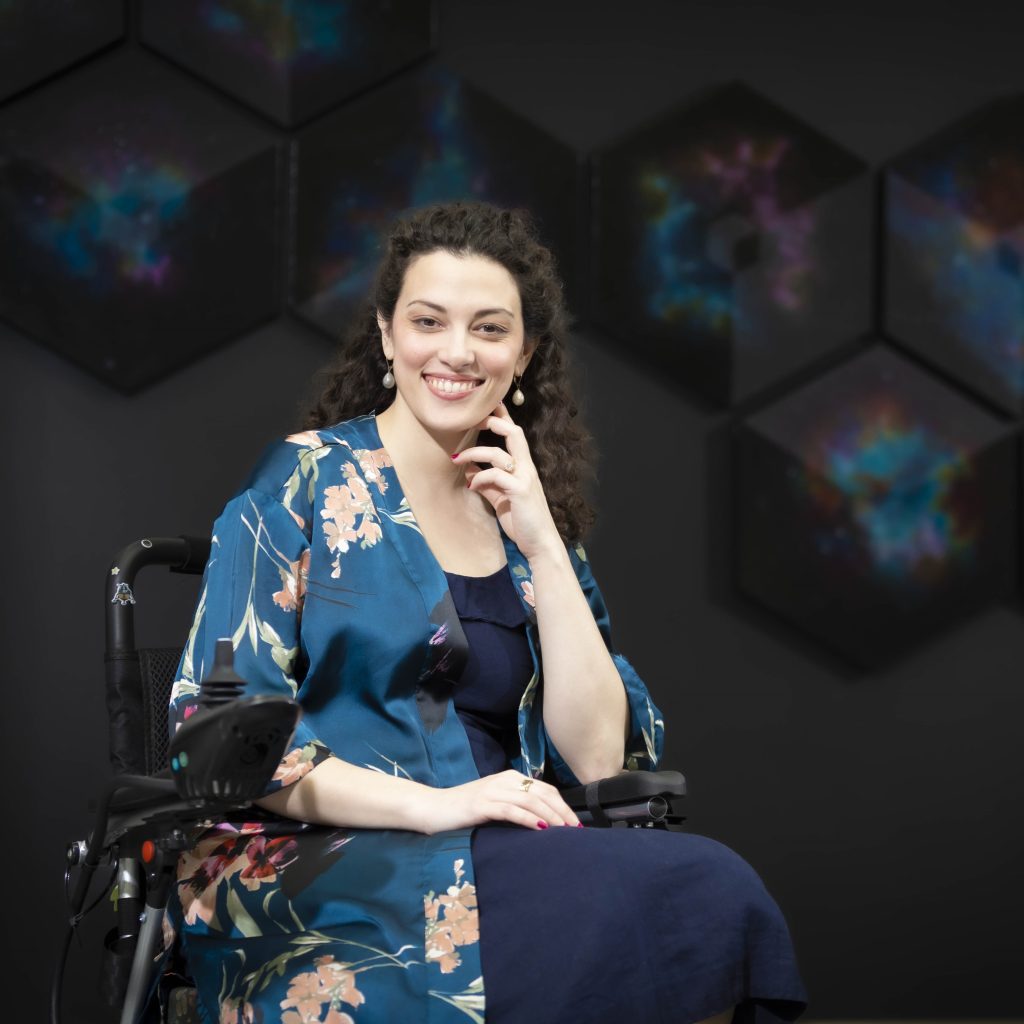
By Dr Zoe Swann
Dr Zoe Swann is a cognitive neurolinguist and Postdoctoral Research Associate at the at the University of Leicester based in the Leverhulme Centre for Humanity and Space. Her research “VITALS” (Voice Indicators of Trust, Adaptation, and Cognitive Load in Spaceflight) sits at the intersection of neuroscience, linguistics, and human factors to validate the voice as a non-invasive and sensitive indicator of astronaut health and wellbeing during long-duration spaceflight.
Space Park Perspectives brings together science, society and the humanities to explore how space is shaping life on Earth — and beyond.
To explore Space Park Leicester partnerships, missions, residents, facilities, training programmes and innovation products, visit space-park.co.uk or to learn more about the University of Leicester visit le.ac.uk/.