


Space Park Perspectives
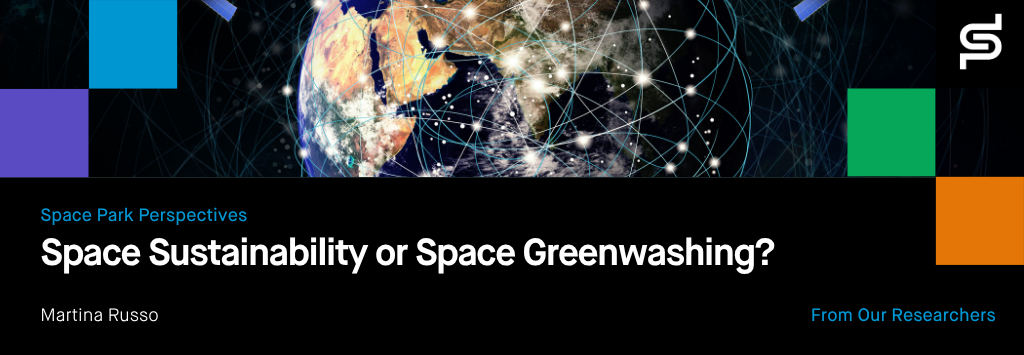
As the global space economy grows at unprecedented pace, sustainability has become one of its defining priorities. But what does “space sustainability” really mean? Dr Martina Russo explores whether the language of sustainability is driving genuine responsibility in space, or simply providing a new narrative for continued expansion, competition and extraction.
Recent years have made one thing unmistakably clear: outer space is no longer imagined solely as a domain of scientific exploration. It is increasingly framed as an economic frontier.
Governments and private companies are investing billions into satellite mega-constellations, lunar missions, commercial infrastructures and future resource extraction projects, while discussions surrounding orbital debris, space traffic management and long-term sustainability have become more urgent than ever.
In parallel, initiatives such as the Earth Space Sustainability Initiative (ESSI), the Astra Carta and growing international debates around responsible space governance reflect an emerging recognition that the future of space activity cannot remain entirely unregulated, or non-binding.
Yet despite the growing visibility of space sustainability as a policy priority, there is still remarkably little agreement on what the term itself actually means.
This became particularly evident to me following recent discussions at the SPARC Summit: For a Sustainable Future in Space. What I found most intellectually stimulating was not simply the range of technical or legal perspectives presented, but the extent to which sustainability appeared to function as a highly flexible concept shaped by very different institutional priorities. For some, sustainability referred primarily to orbital resilience and debris mitigation.
For others, it aligned with maintaining long-term commercial viability, economic growth and strategic competitiveness. Legal and governance perspectives focused on international coordination and regulatory frameworks, while humanities and social science approaches introduced questions of ethics, responsibility, discourse and public accountability. These differences are not necessarily problematic. Interdisciplinary conversations are valuable precisely because they expose competing assumptions rather than conceal them. But listening across these perspectives, I am even more convinced that sustainability in space is fundamentally a political and ethical question about priorities.
What exactly are we trying to sustain? Are we trying to preserve orbital environments? Support scientific progress? Ensure commercial access? Expand human presence beyond Earth? Protect national strategic interests? Sustain economic growth?
And when these priorities come into tension — as they inevitably will — whose priorities ultimately prevail? These questions matter because the governance structures currently shaping outer space remain deeply fragmented. International space law still relies heavily on treaties written in a different time and global scenario, long before the rise of private space corporations, satellite mega-constellations and ambitions for extraterrestrial resource extraction.
While initiatives such as ESSI or the Astra Carta represent important attempts to encourage responsible behaviour and establish shared principles across the sector, many sustainability frameworks remain voluntary rather than legally binding, which creates a significant structural tension. When sustainability depends primarily on voluntary commitments, implementation is inevitably shaped by the interests of actors operating within increasingly competitive geopolitical and commercial environments. Economic pressures, strategic rivalries and market incentives can easily redefine what sustainability means in practice. As a result, sustainability risks becoming flexible enough to accommodate almost any agenda. This is where a more critical perspective becomes necessary.
Much contemporary discourse surrounding outer space still relies heavily on narratives of expansion, extraction and competition. Terms such as “space economy”, “resource utilisation”, “commercial frontier” and above all “space race” are often treated as neutral descriptions of technological progress. But language is never neutral. The metaphors and narratives we choose actively shape political priorities, institutional behaviour and public imaginaries.
I find myself wondering whether some forms of “space sustainability” risk becoming a kind of space-washing: the adaptation of sustainability language to legitimise continued expansion, extraction and commercial competition beyond Earth. The parallel with what has happened and still happens on Earth is difficult to ignore. Sustainability rhetoric can sometimes function less as a transformative framework and more as a mechanism for rendering existing models of growth ethically acceptable. In this sense, the problem is not simply whether sustainability is being discussed, but how it is being framed — and to what ends. This becomes particularly visible in the recurring rhetoric of the “new gold rush” in space exploration. Across political discourse, media narratives and industry communication, outer space is frequently represented as the next frontier of untapped wealth and economic opportunity. The language of colonisation and expansion persists, and framing space through these imaginaries carries important ideological consequences. It normalises competition over cooperation and extraction over stewardship. More importantly, it risks reproducing on a cosmic scale many of the same logics that contributed to the ecological crisis on Earth in the first place.
Of course, space exploration offers extraordinary scientific possibilities. Satellite technologies already play an essential role in climate monitoring, environmental observation and global communications. Space research can contribute enormously to addressing terrestrial challenges. But this is precisely why the current conversation about sustainability matters so deeply. At a time of escalating ecological crises on Earth, perhaps the most urgent question is not how quickly we can expand into space, but whether we can imagine forms of progress that are not structured primarily around extraction, competition and endless growth. Because ultimately, the futures we build in space will reflect the values we choose to normalise on Earth. And if sustainability is to mean anything at all beyond a strategic slogan, then it must begin not with conquering new frontiers, but with learning how to inhabit shared worlds more responsibly, including our own.

Dr Martina Russo is a Research Associate at the Leverhulme Centre for Humanity and Space.
Through an interdisciplinary approach that bridges linguistics, environmental humanities, and space studies, Dr Martina Russo explores how narratives shape collective understandings of sustainability, responsibility, and justice. Her work contributes to emerging debates on environmental and space governance by examining the role of language in imagining more equitable and sustainable futures for both Earth and outer space.
Space Park Perspectives brings together science, society and the humanities to explore how space is shaping life on Earth — and beyond.
To explore Space Park Leicester partnerships, missions, residents, facilities, training programmes and innovation products, visit space-park.co.uk or to learn more about the University of Leicester visit le.ac.uk/.
Main image: Illustration of internet satellites orbiting Earth