


Space Park Perspectives
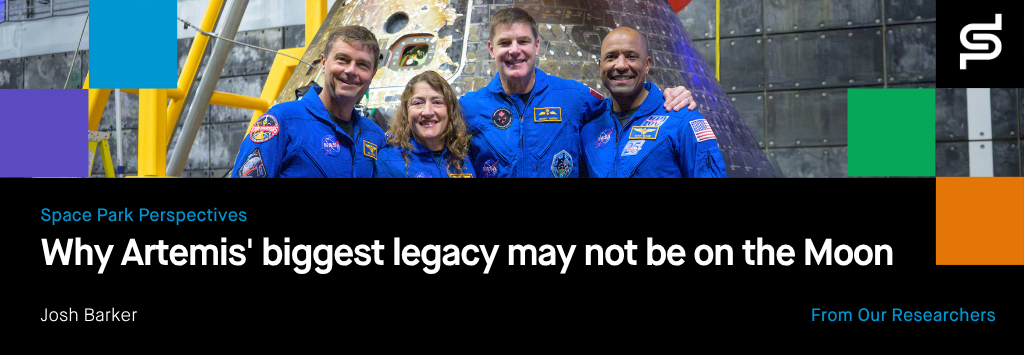
NASA’s Artemis missions will advance lunar exploration, but their greatest achievement could be inspiring the scientists, engineers and explorers of tomorrow. Space Park Leicester’s Education and Outreach Officer, Josh Barker, explains why the programme’s human stories may leave the most lasting legacy of all.
The human stories behind the Artemis space exploration programme have the power to generate inspiration which could far outweigh any scientific breakthroughs, experts at Space Park Leicester have said after NASA named the crew for its next mission.
Earlier this month, NASA revealed its crew for Artemis III, the mission scheduled for 2027 ahead of the planned Moon landing by Artemis IV the following year.
The Artemis III mission, which is expected to last about two weeks, will focus on testing the equipment, technology and spacecraft in low Earth orbit in readiness for Artemis IV. Along with the testing and advancing of docking operations, the mission will also see the launch of the world’s most powerful rockets.
At the helm will be the Artemis III crew – commander Randy Bresnik, pilot Luca Parmitano and mission specialists Andre Douglas and Frank Rubio.
With NASA describing the Artemis programme as “a new Golden Age of exploration”, it is the human element to the missions that experts at Space Park Leicester say has captured the public’s imagination and could inspire future generations of space enthusiasts and interest in space-related careers.
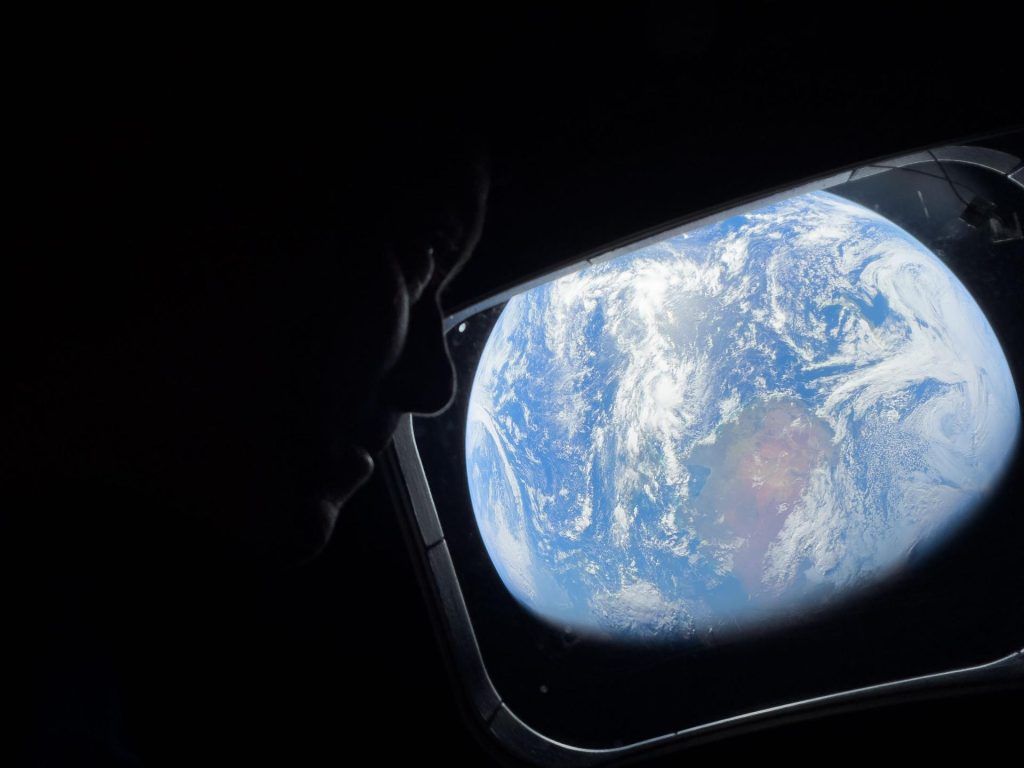
Image Credit: NASA
Artemis’ ‘inspiration effect’ could be its biggest legacy, Space Park Leicester predicts
Josh Barker, Space Park Leicester’s Education and Outreach Officer, said this ‘inspiration effect’ could prove to be Artemis’ biggest legacy, rather than any scientific advancements that are made.
He said: “The biggest impact seen from the Apollo programme in the 1960s was not necessarily scientific – it was the sheer inspiration it generated. We’ve heard from people who say it was watching the Moon landing on television that inspired them to work in the space sector.
“What’s resonating with people about the Artemis programme is the human story. In the space sector, we’re achieving amazing things on almost a weekly basis, but they don’t often connect with people because it involves technology.
“When there’s a human story involved, you start to engage with people and get that personal connection. People start to imagine how it might feel looking back down at Earth. That’s the power of the Artemis programme.
“Looking ahead to the moment when we see an image of someone on the Moon – that will be magic. That’s the human moment people get excited about.”
The inclusion in the Artemis III crew of Italian astronaut Luca Parmitano, from the European Space Agency, demonstrates the international collaboration within the scientific community, Josh said.
“Apollo was very much an American programme. What we are seeing now is other nations being brought in and I’m sure we’ll see more of that as the Artemis programme develops,” Josh commented.
Josh said the emergence of British astronaut Tim Peake, who spent time on the International Space Station, created a ripple effect and sparked more interest in the space sector and careers in this field, and even led to a spike in visitors to science museums.
Space Park Leicester and the University of Leicester regularly host schools and colleges to engage young people with STEM subjects and careers in space. Next week, 70 students will visit the university to take part in a physics experience programme which will showcase the real-world roles of physicists.
In September, the university will collaborate with STEM Learning on its Space 3D Leicester programme. This project will introduce around 200 students to 3D printing and additive manufacturing with space missions as a context to exploring this technology.
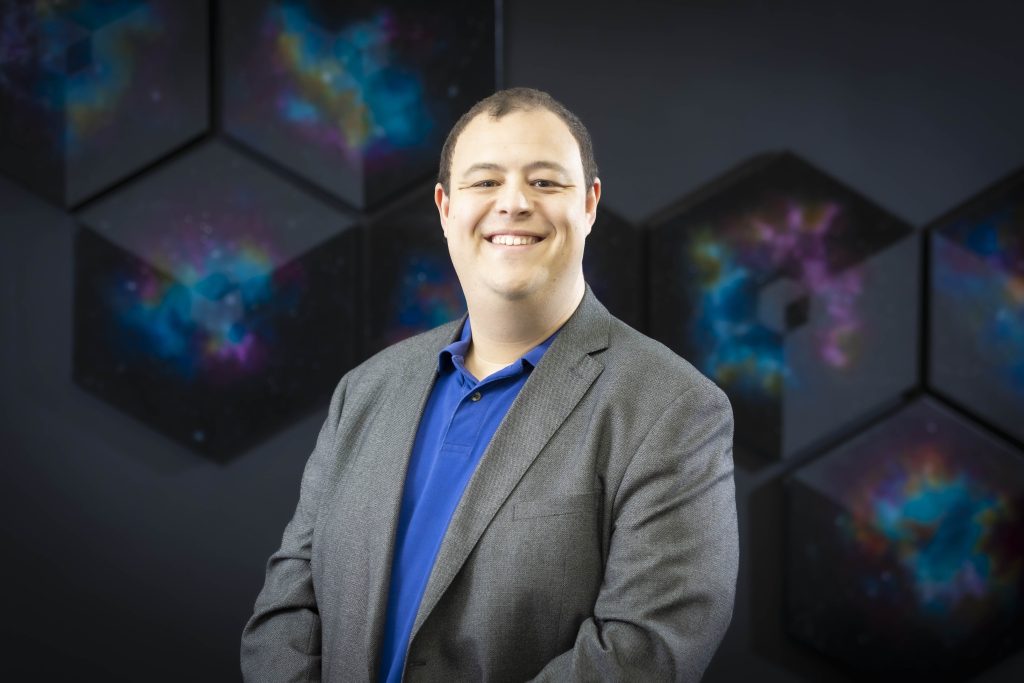
By Josh Barker
Josh is an experienced presenter with a demonstrated history of working in the museums and institutions industry. Strong education professional skilled in Science Education, Presentation, Customer Service, Physics, and Astrophysics.
Space Park Perspectives brings together science, society and the humanities to explore how space is shaping life on Earth — and beyond.
To explore Space Park Leicester partnerships, missions, residents, facilities, training programmes and innovation products, visit space-park.co.uk or to learn more about the University of Leicester visit le.ac.uk/.
Main image: Artemis II Recovery
NASA astronauts Reid Wiseman, commander; left, Christina Koch, mission specialist; CSA (Canadian Space Agency) astronaut Jeremy Hansen, mission specialist; and NASA astronaut Victor Glover, Artemis II pilot, right, pose for a group photo after viewing the Orion spacecraft in the well deck of USS John P. Murtha, Saturday, April 11, 2026, in the Pacific Ocean off the coast of California. The quartet splashed down Friday, April 10 at 5:07 p.m. PDT (8:07p.m. EDT).
Image Credit: NASA/Bill Ingalls