


Space Park Perspectives
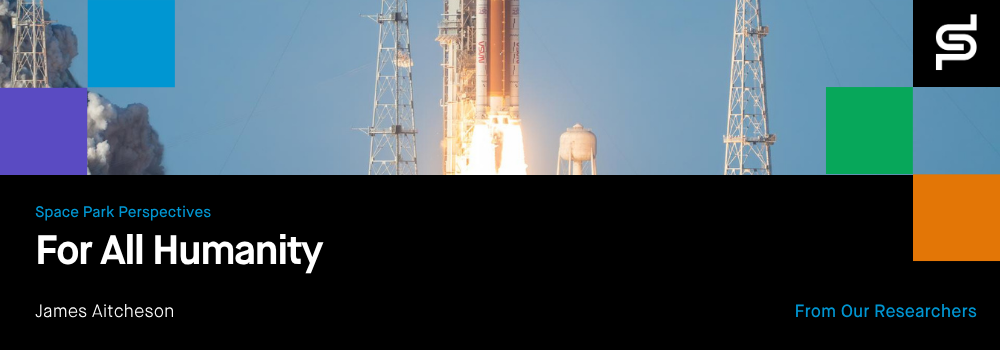
As Artemis II reignites global fascination with human spaceflight, Dr James Aitcheson explores why space still captivates us — and why understanding its cultural and human impact is more important than ever.
What most struck me while I was watching the launch countdown for Artemis II on 1 April was not the rocket stack, attached by its umbilicals to the tower, hissing like a leashed animal as its cryogenic propellants boiled off. Nor was it the composure of the astronauts as they settled within the confined Orion capsule that was to be their home for the next ten days.
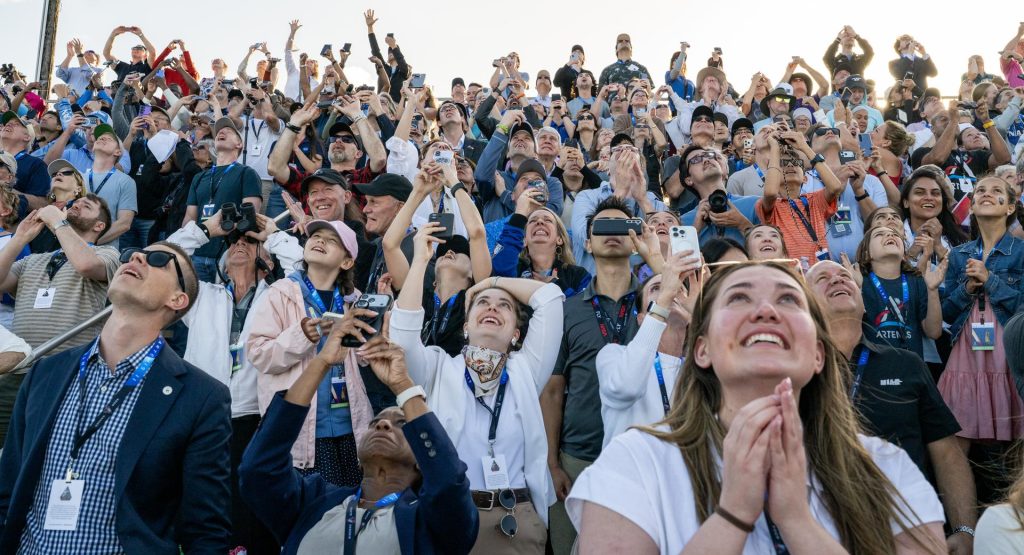
Rather, it was the sheer number of spectators who had gathered not just at Cape Canaveral, where they packed the stands, but also – as became clear from NASA’s official livestream – in Washington, DC, and at the Marshall Space Flight Center in Huntsville, Alabama, where many were watching remotely.
Thousands of people, who had turned out in hope, without any guarantee that the launch wouldn’t be scrubbed due to bad weather or technical faults. The countdown was at L minus four hours when I began watching via NASA’s YouTube channel, along with what would eventually be more than 18 million others. All of us waiting for that moment when the candle would be lit: the plumes of smoke around the pad, the pillar of flame bursting from the base of the stack, the roar and crackle of the engines.
The voices of those interviewed at Cape Canaveral held both wonder and reverence – for the technology, and for the astronauts themselves. NASA employees spoke sincerely of the collective achievement of all who had worked to bring the Artemis programme to this point. But the crowd shots told a different story, as they panned across adults and children alike beaming with giddy delight. The scene as a whole resembled a cross between a religious service and a music festival.
The aim of putting humans on the Moon isn’t new, of course. All of this has been done before. The destination is familiar. Certain components, including the solid rocket booster (SRB) segments and the RS-25 engines, are derived from the Space Shuttle. These pieces of hardware ultimately date back to designs first conceived in the 1970s. In lots of ways, the Artemis programme is re-treading old ground. It has also received criticism from some quarters for lacking clearly defined objectives, and having limited scientific benefits to justify its excessive cost.
And yet despite all of this, the idea of putting human beings into space, more than six decades after Yuri Gagarin’s first orbit around the globe, clearly retains an emotional pull that is difficult to place a value on or even to rationalise. Spaceflight clearly means something to a lot of people – certainly in the United States, but also around the world.
We still live in a geocentric universe, perhaps not in cosmological terms, but certainly on a practical and everyday level. The notion of people like us heading out into the wider universe – even if only for ten days, and only as far as our own satellite – presents a profound challenge to how we perceive our place in the universe. It is an escape from Earth, in more than one sense.
Closer to home, here at Space Park Leicester, I’m delighted to be present at the launch of a very different but equally exciting project: one which plans to explore precisely these issues concerning humanity’s relationship with space. The Leverhulme Centre for Humanity and Space (LCHS), where I am one of seven new postdoctoral Research Associates, has been established to advance arts, humanities, and social sciences research into what space means to us politically, socially, and culturally.
How can we live and work better in space? How do we ensure it is used for peaceful purposes, while balancing competition and collaboration among nations? How do we communicate and represent our experiences of space? And how do we develop strategies for equitable exploration that promote sustainability, development, and fairness?
These are some of the questions we hope to address over the course of our ten-year mission, funded by the Leverhulme Trust. Much as the Artemis programme aims to mark a new era in space exploration, the LCHS – which formally began life in February, based at Space Park – aims to kickstart a new era in space studies.
I’ve long held an interest in space. I grew up during the heyday of the Space Shuttle, and was captivated by images from the Voyager probes and the Hubble Space Telescope. What I’m particularly interested in, though, is the human aspect: how people over the centuries have responded to what’s out there; and how our understanding of and relationship with space have developed over time.
I consider myself immensely privileged to be a part of this new, interdisciplinary research centre, and to have joined it at the very start of its mission. Homo sapiens is still very much in its infancy as a spacefaring species; our attitudes towards space are fast evolving. As we start to venture further, how will they continue to evolve? I’m looking forward to finding out.
Shortly before lift-off of Artemis II, after the crew were told they were ‘go for launch’, mission specialist Jeremy Hansen replied, ‘We are going for all humanity’. It’s worthwhile remembering that, even though spaceflight might still be the preserve of national space agencies, corporations, and billionaires, space itself is something that we all have a stake in.
The skies belong to no one, and they belong to everyone.
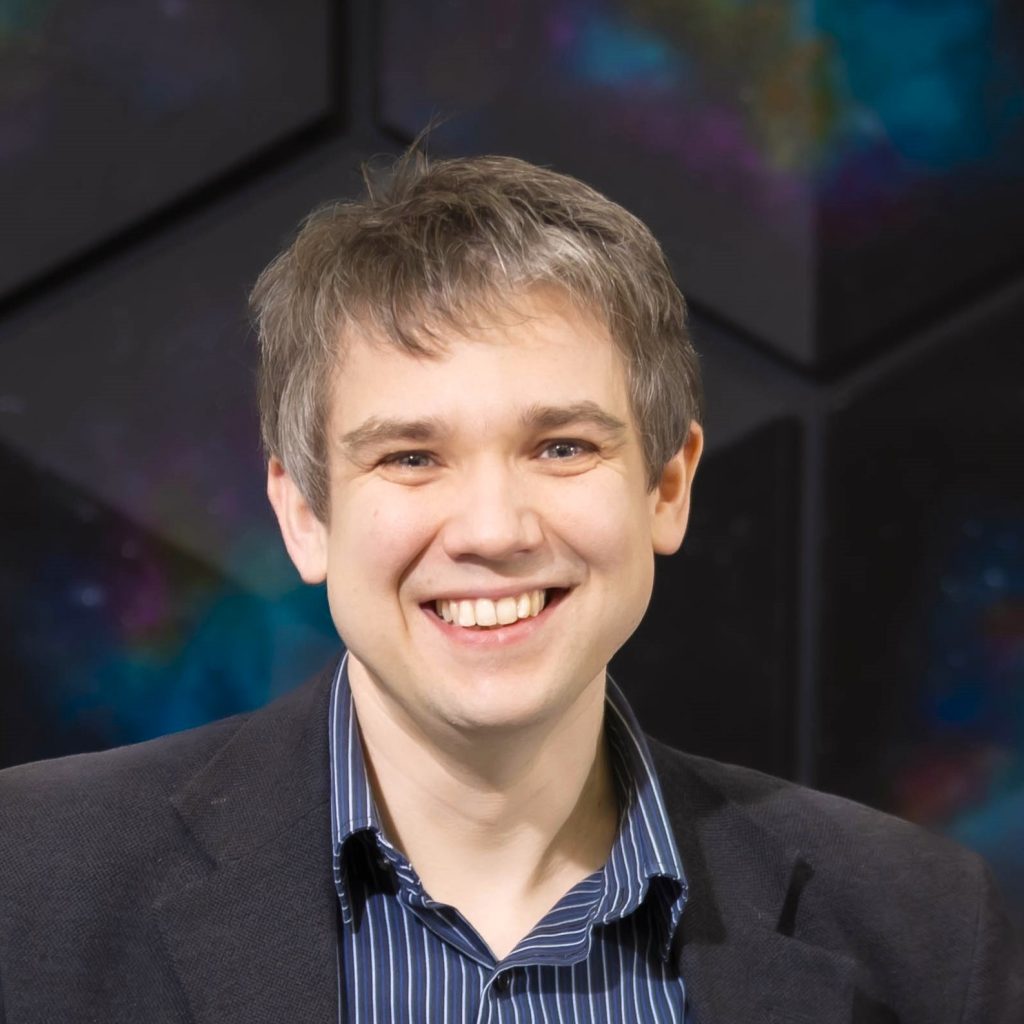
James is a Research Associate at the The Leverhulme Centre for Humanity and Space, based at Space Park Leicester. His research explores astronomy in the Middle Ages, and representations of space in contemporary literature.
Space Park Perspectives brings together science, society and the humanities to explore how space is shaping life on Earth — and beyond.
To explore Space Park Leicester partnerships, missions, residents, facilities, training programmes and innovation products, visit space-park.co.uk or to learn more about the University of Leicester visit le.ac.uk/.