


University of Leicester telescope to launch next Spring

A cutting-edge telescope developed by experts at the University of Leicester for the Solar Wind Magnetosphere Ionosphere Link Explorer (SMILE) mission will launch next Spring following the successful completion of a 10-month Assembly Integration and Testing phase.
Set to give humankind its first complete look at how Earth reacts to streams of particles and bursts of radiation from the Sun, SMILE is a joint mission between the European Space Agency (ESA) and the Chinese Academy of Sciences (CAS).
Following completion of its 10-month AIT phase from November 2024 to September 2025 at ESA’s technical centre ESTEC, in the Netherlands, the mission is scheduled to launch between 8 April and 7 May on a Vega-C rocket from Europe’s Spaceport in French Guiana.
The Soft X-ray Imager (SXI) on SMILE is led by the University of Leicester and is a wide-field X-ray telescope that uses micropore optics to spectrally map the location, shape, and motion of Earth’s magnetospheric boundaries.
It is the first instrument to be delivered using facilities at Space Park Leicester, as the Assembly, Integration and Test (AIT) Team successfully integrated space-flight subsystems to complete the SXI Telescope within a purpose-built cleanroom.
Dr Steven Sembay, SMILE SXI Principal Investigator at the University of Leicester, said:

“SXI is a powerful but compact X-ray telescope that has been challenging to design within the constraints on size, mass, and the demanding space environment imposed by the SMILE mission.

“Successfully completing the intensive Assembly, Integration and Testing phase is a major achievement and a clear reflection of the dedication and technical skill of our university-based engineers here in the UK, as well as the outstanding support from our international consortium. With the launch window now confirmed, it is incredibly exciting to see SXI one step closer to orbit and to the groundbreaking science it will soon deliver.”
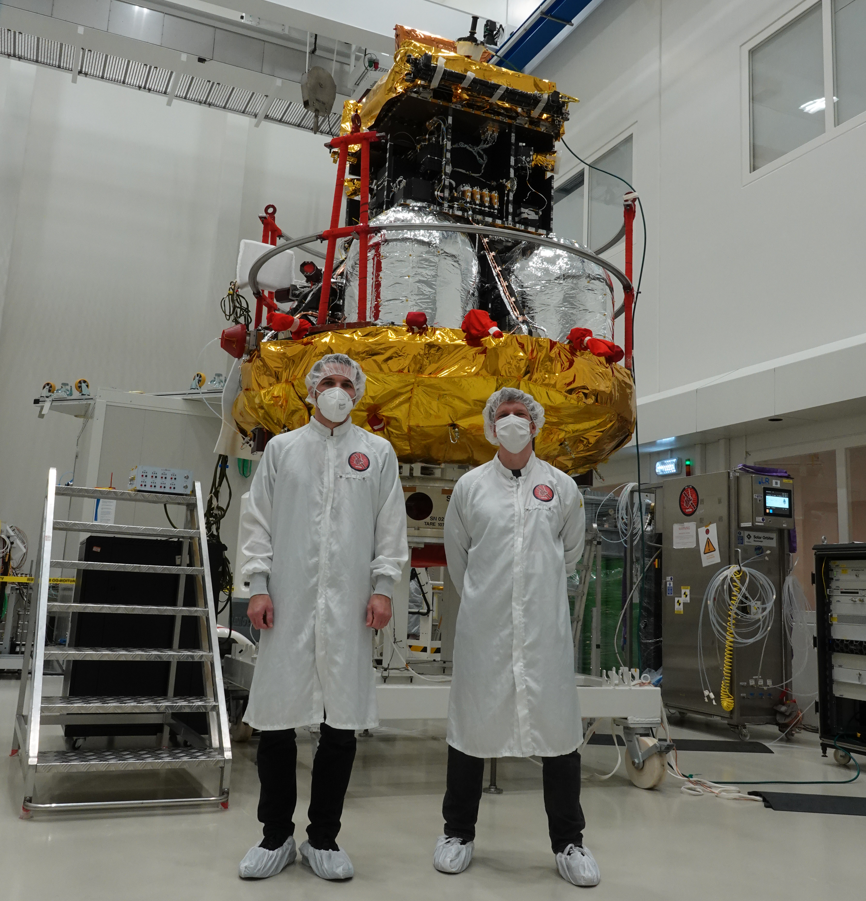
The SXI has been developed and built in collaboration between the University of Leicester, Mullard Space Science Laboratory (MSSL) and the Open University within the UK and several institutions across Europe. UK space engineers have provided key subsystems in the form of the main telescope assembly, X-ray optics module, advanced X-ray detector system and the associated readout electronics.
Space weather brings potential risks such as radio blackouts, disruptions to satellites and power grid failures. SMILE will study how the solar wind interacts with the Earth’s magnetic environment.
Dr Jennifer Carter from the University of Leicester School of Physics and Astronomy said: “Our Earth is protected from the solar wind by its magnetic field, which acts like a shield. SMILE will transform our understanding of this highly dynamic magnetosphere.
“SXI will image this magnetic shield, whilst a different camera will take ultraviolet pictures of aurora in the Northern Hemisphere. For the first time ever, we will see how changes to this shield cause effects in the upper atmosphere at the same time.”
The UK Space Agency has supported the delivery of this instrument with approximately £13m of funding, building on the agency’s mission to invest in cutting-edge technologies and world class science that bring the benefits of space back to citizens on Earth.
This a major milestone for Space Park Leicester and a huge achievement for the University of Leicester who led this international team to develop the cutting-edge instrumentation for SMILE, that will help experts to understand more about the solar wind and how space weather can impact Earth.
Main image: SXI in the Space Park Leicester Cleanroom
To explore Space Park Leicester partnerships, missions, residents, facilities, training programmes and innovation products, visit www.space-park.co.uk or to learn more about the University of Leicester visit https://le.ac.uk/.