


Leicester researchers use satellites to tackle landfill methane leaks

Researchers in Leicester are leading an international project using satellites to help curb methane emissions from landfill sites.
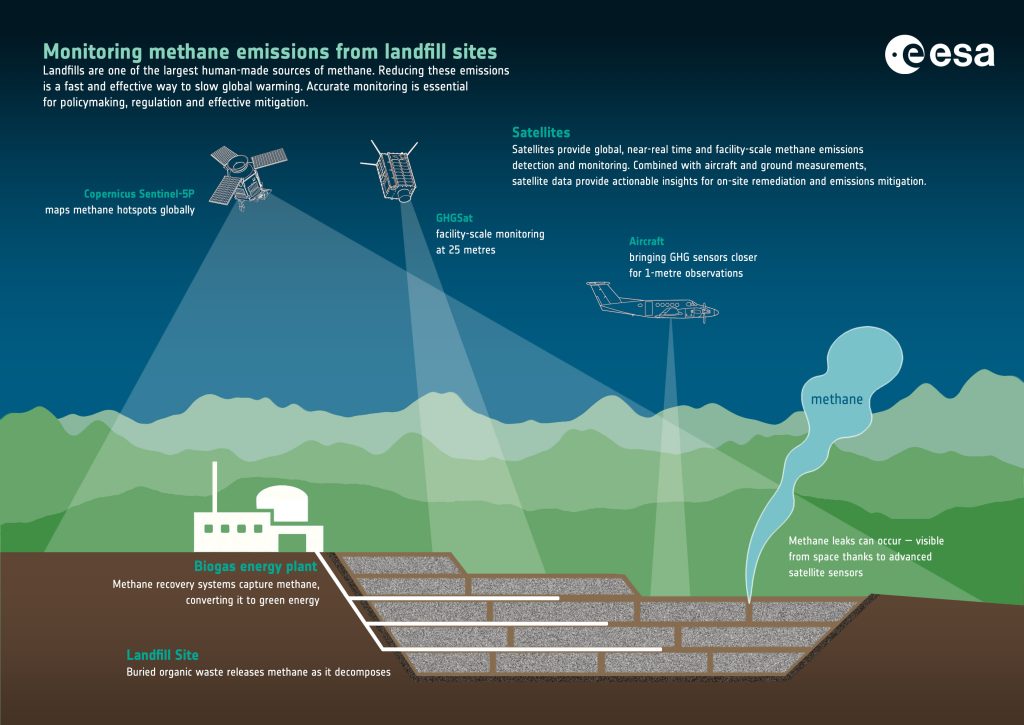
Methane gas is a more potent greenhouse gas than carbon dioxide per tonne that contributes to global warming and landfill sites account for more than 10 per cent of human-caused methane emissions.
A research team, led by Dr Harjinder Sembhi, of the University of Leicester’s School of Physics and Astronomy and Space Park Leicester, is testing how space-based technology can help find leaks and then assess whether repairs have worked in a real-world case study in Spain.
Since Spring 2025, Dr Sembhi and her team have worked with the European Space Agency (ESA) and the managers of the Las Dehesas landfill site – Madrid City Council and Urbaser – to collect methane emission measurements from the site using ground surveys, sensor-equipped aircraft and satellites. The project is part of ongoing work within and alongside ESA’s Climate Change Initiative MEDUSA (Methane Emissions Detection Using Satellites Assessment) which is comparing and evaluating methane data products on hot spot and point sources from a large variety of satellites.
Dr Sembhi said: “In many cases, the operator was able to check leak locations as we were disseminating data reports and prioritise action.

“Landfill gas production is generally of a diffuse nature, influenced by dynamic and changing site activity as well as potential influence of prevailing weather and ground conditions.”
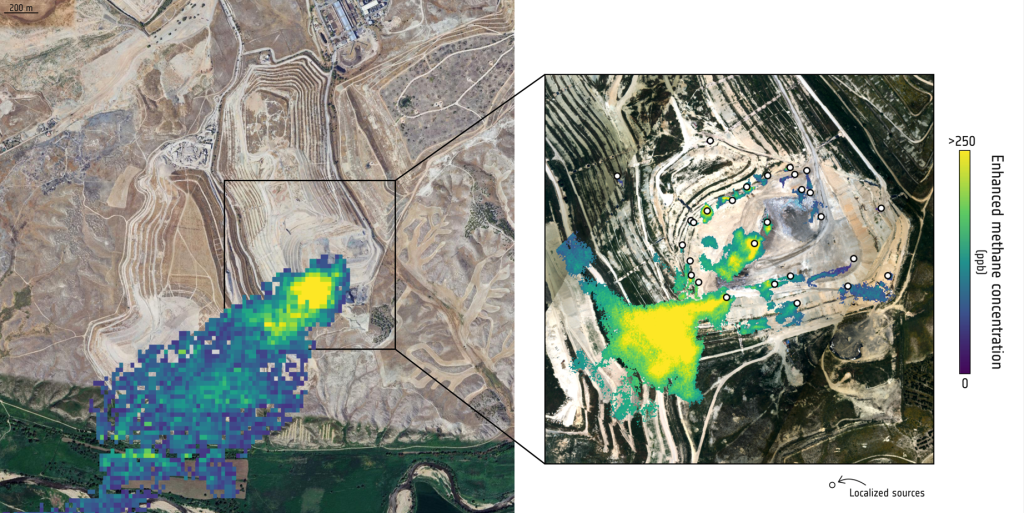
Credit: UoL/GHGSat/ESA.
Dr Dan Potts, a researcher in the team said “Using these satellite and aircraft observations, site information and local meteorological data we can pinpoint exact leak locations and better understand emission variability. This unique dataset will help us improve our understanding of landfill emissions more broadly, which should help us better understand these complex sources and inform practical steps to reduce or avoid emissions entirely.”
Previous satellite-based surveys of methane emissions from landfill sites have found little correlation with reported or modelled emission estimates at facility scale, revealing major uncertainties in current understanding.
Dr Sembhi added: “The opportunity to work with the operator can help us optimise the use of remote sensing to improve monitoring. This will allow us to identify the reasons for the gap between satellite-based and facility-calculated methane emissions, and lead to real-world emissions reductions.”
The results of the field study are expected to be available in early 2026, with evaluation of the remediation activity effectiveness currently on-going.
Dr Sembhi concluded: “Detection is only one half of the coin. We’re assessing how robust and long-lasting the remediation has been in terms of plugging leaks.
“Once complete we’ll advance knowledge of monitoring and quantifying waste sector emissions, while laying the groundwork for satellite-driven landfill methane monitoring to support cities and waste managers in cutting emissions.”
Main image: Observed methane emissions from the Las Dehesas landfill in Madrid, as seen from satellite observations
Credit: UoL/GHGSat/ESA.
To explore Space Park Leicester partnerships, missions, residents, facilities, training programmes and innovation products, visit www.space-park.co.uk or to learn more about the University of Leicester visit https://le.ac.uk/.