

From planets to Plantagenets: the role of space science in identifying Richard III’s remains
When University of Leicester scientists worked to identify the mortal remains of King Richard III, they combined expertise drawn from the worlds of archaeology, genetics, forensics – and even space exploration.
Eleven years ago to the day, the King’s remains would make their final journey to be reinterred at Leicester Cathedral. But the journey to confirm that these were definitely the remains of the last Plantagenet King of England was not a simple one.
Like a court case, different strands of evidence had to come together to build a conclusion beyond reasonable doubt. But a crucial part of this effort was preventing contamination of the remains from modern DNA, and even tiny contamination can distort results. Luckily, the University of Leicester already had a facility designed precisely for this purpose – except that their work is usually less terrestrial and more extra-terrestrial in nature.
Close encounters
One evening in 2012, John Holt from the School of Physics and Astronomy received a call from the late Professor George Fraser, then Director of the Space Research Centre.
John said: “At that point, I hadn’t been following the excavation and wasn’t involved. George told me, in strict confidence, that the team believed they had found the remains of King Richard III.”
The remains of Richard III had been exhumed by the archaeologists in the Grey Friars car park. For this project, John’s role wasn’t to identify the remains directly, but to ensure they were protected from contamination. This would allow geneticist Professor Turi King and her team to carry out precise DNA analysis with confidence.
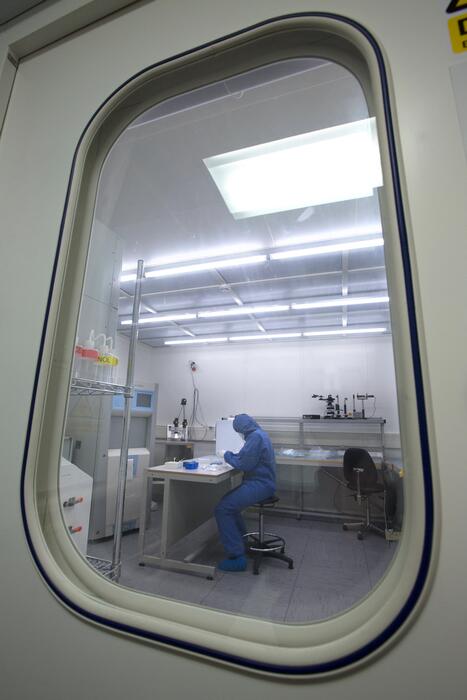
John’s background is in planetary protection; preventing contamination of sensitive samples from space and planets like Mars. The Space Research Centre had a specialist cleanroom designed for assembling space hardware, where even microscopic contamination can jeopardise missions. This facility had previously been used for projects such as the XMM-Newton space telescope and early work on the Beagle 2 Mars lander. That level of cleanliness made it ideal for handling the remains.
“You don’t always realise the importance of your contribution at the time.” John reflected.

“My work focuses on Mars sample return missions, where preventing contamination is critical. Even a single skin cell could compromise scientific results.

“My research is focused on developing ultra- clean, high containment technology to support a Mars Sample Return mission where precious samples are brought back to Earth for analysis. NASA’s MSR mission is on hold, but other countries, like China, are also planning to retrieve rock samples from the red planet and bring them to laboratories on Earth. The Double Walled Isolator technology developed at Leicester is unique and could be used to support that endeavour.

“The parallels are very strong. Whether analysing ancient remains or Martian rocks, the challenge is the same: preserving the scientific integrity of the sample so the analysis can be trusted.”
A particular challenge
Cleanroom science has its roots in 19th-century advances in sterile techniques, with efforts led by Lord Lister at the Royal Infirmary Glasgow showing that a clean environment had the effect of significantly reducing post-operative infection and sepsis. But modern facilities operate at an extraordinary level of higher precision.
To give a sense of scale: a human hair is about 80 microns wide, while John and his team were concerned with particles as small as 0.5 microns (over 100 times smaller). Typical indoor air can contain tens of millions of such particles per cubic metre. In contrast, the Space Research Centre cleanroom operated at levels so low that most measurements recorded virtually zero particles.
“The biggest challenge, however, is people.” John said. “Humans shed around 30,000 skin cells per minute, making us the main source of contamination.
“Interestingly, many people have unknowingly been inside a cleanroom, hospital operating theatres are a good example. Cleanrooms work by continuously filtering air to remove microscopic particles and maintaining positive pressure to prevent contamination from outside getting in.
“In our case, it ensured that tiny traces of modern DNA, such as skin cells, did not contaminate the remains and interfere with analysis used to make the genetic identification. The same principle applies to the assembly of space hardware, where we don’t want particles on delicate optics, for example.”
Making science history
John is now based at Space Park Leicester, where they continue to develop ultra-clean technologies, like the DWI project. Space Park Leicester is also equipped with a state-of-the-art cleanroom, except it is much bigger and designed to accommodate projects ranging in size from a small space satellite to a delicate space instrument, like FDSPP and SMILE. While his sights are once again turned to the stars, his experience on the Richard III project remains highly relevant.
“This came at an important stage in my career, when I was beginning to lead my own research. It gave me the opportunity to collaborate across disciplines and contribute to a landmark study, including co-authoring a paper in Nature.
“This was different because it covered so many academic domains, history, archaeology, DNA analysis, medical forensics, medical physics, osteology, palaeontology, and in my case, space science. From my perspective it was amazing to see so many scientific disciplines brought to bear on answering a 500-year-old forensics question.
“Physics underpins many of the tools and techniques used to solve real-world problems, from medical imaging (as was used for Richard III) to space exploration where we are looking for evidence of life outside of the Earth. It provides the foundation for understanding and measuring the world around us. It’s an incredibly versatile subject that equips an individual with a detailed understanding of not just how things work, but also why they work. Combined with critical thinking and a range of analytical techniques, physics allows one to pursue careers in science, engineering, research, finance and banking, education and so many more.
“RIII was a once-in-a-lifetime opportunity to apply space science techniques to a historic discovery; methods that still shape my research today. If I’m honest, I didn’t immediately think of it that way. Over the years, I’ve seen how certain research projects can suddenly capture public imagination, and this was one of them. What made it truly remarkable was the level of collaboration across the University. That teamwork was key to its success.”
To explore Space Park Leicester partnerships, missions, residents, facilities, training programmes and innovation products, visit space-park.co.uk or to learn more about the University of Leicester visit le.ac.uk/.
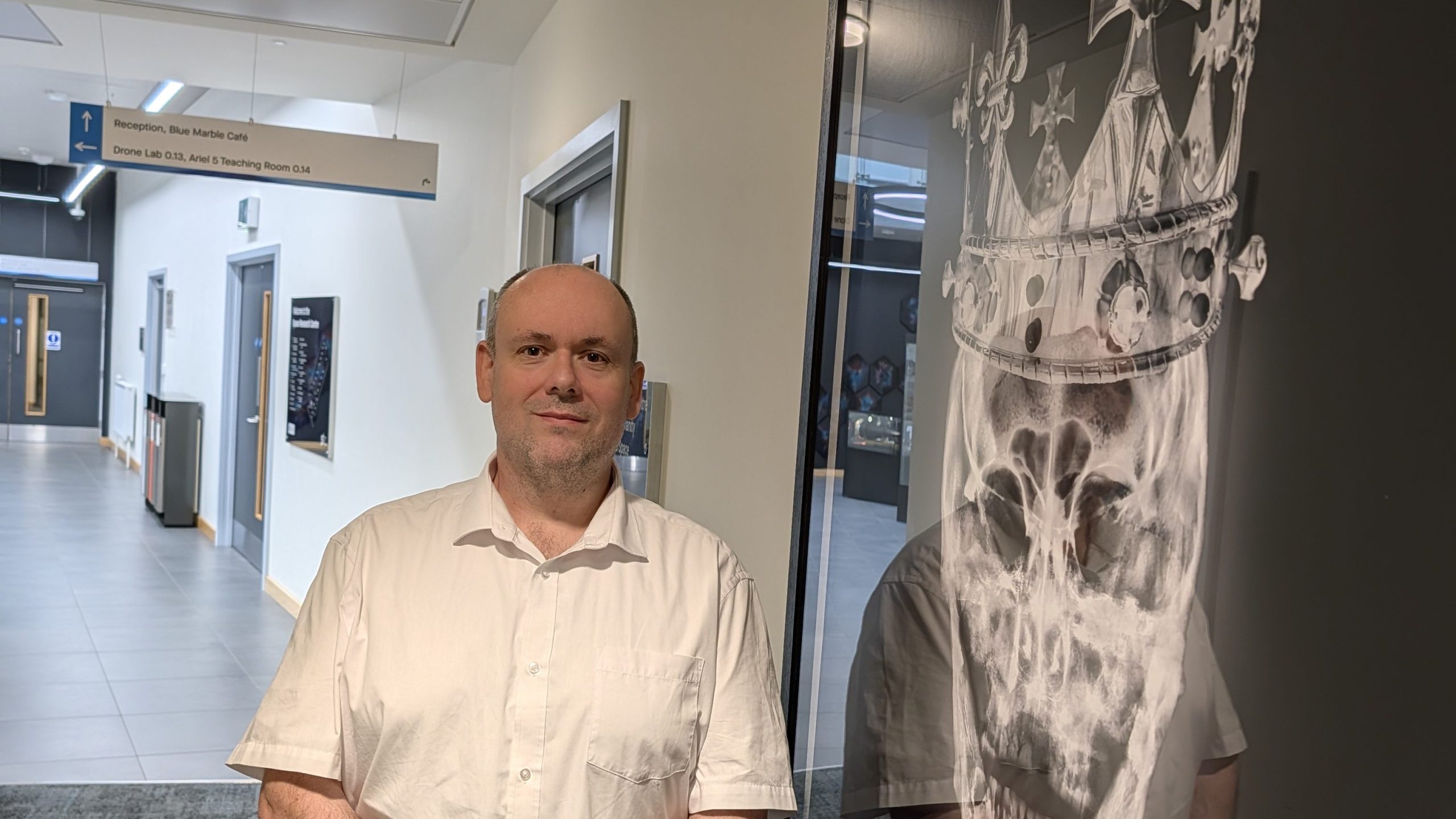
Main image: John Holt with a King Richard III artwork on display at Space Park Leicester