


Frontier Space helps shape Europe’s next frontier in space-enabled health
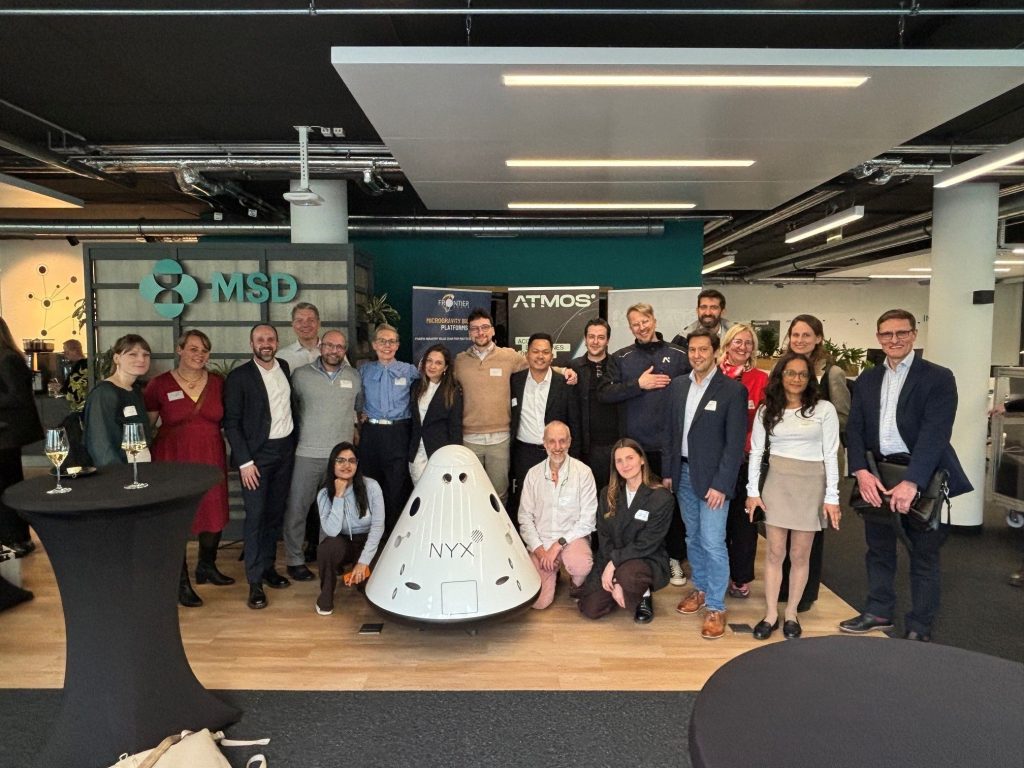
As Europe approaches a pivotal moment in the future of space research, one Space Park Leicester alumni company is helping to lead the charge.
Frontier Space, a graduate of the ESA Business Incubation Centre at Space Park Leicester and resident partner, is playing a central role in a major new European collaboration focused on unlocking the potential of microgravity for life sciences and healthcare.
At a high-level symposium in Berlin hosted by the European Space for Health Alliance (ESHA), Frontier Space joined leaders from across the space, biotech and pharmaceutical sectors to tackle one of the most pressing challenges facing Europe: how to secure reliable, scalable access to microgravity research beyond the lifetime of the International Space Station.
A new era for biomedical innovation
Microgravity is rapidly emerging as a powerful environment for accelerating medical discovery. From neurodegenerative diseases such as Alzheimer’s and Parkinson’s to cancer and musculoskeletal conditions, space-based research offers the potential to compress years of laboratory work into significantly shorter timeframes.
But realising that potential depends on more than science alone.
It requires infrastructure — the ability to transport, host and safely return sensitive biological experiments from orbit.
This is where Frontier Space is making its mark.
Turning ambition into capability
At the Berlin symposium, Frontier Space presented progress from BRIDGE, a UK Government-funded initiative developed in partnership with The Exploration Company and MSD.
The project is addressing one of the biggest bottlenecks in space-enabled life sciences: how to create standardised, reliable logistics for biological research in orbit.
From environmental control to sample integrity, BRIDGE is laying the groundwork for a future where pharmaceutical research in space becomes routine, scalable and commercially viable.

As Aqeel Shamsul, CEO of Frontier Space, explains:

“Microgravity-enabled medicine is poised to be a strategic asset for Europe. Building reliable commercial pathways for biological research in space is not only a scientific priority, but a strategic one.”
From Leicester to low Earth orbit
Frontier Space’s journey is a powerful example of how Space Park Leicester is enabling the next generation of space-driven innovation.
Through the ESA Business Incubation Centre, Space Park Leicester supports ambitious start-ups working at the intersection of space, science and industry — helping them translate breakthrough ideas into real-world impact.
Frontier Space’s work now sits at the heart of a growing European effort to build the infrastructure needed for a new industrial domain: space-enabled health and biomanufacturing.
Securing Europe’s competitive edge
With the International Space Station set to retire by 2030 and global investment in pharmaceuticals shifting rapidly, Europe faces a narrowing window to act.
Without coordinated investment in next-generation space infrastructure, there is a risk that world-class research capability will not translate into industrial and societal value.
Initiatives like ESHA — and companies like Frontier Space — are helping to change that.
By building the platforms, partnerships and pathways needed to operate in orbit and return results to Earth, they are ensuring that Europe remains at the forefront of both space innovation and life sciences.
A future built on partnership and possibility
For Space Park Leicester, this is exactly what the ecosystem was designed to do.
To connect academia, industry and government. To accelerate innovation. And to enable organisations like Frontier Space to push beyond boundaries — from Leicester to low Earth orbit, and back again with discoveries that could transform life on Earth.
Frontier Space is a UK space biotech company building platform technology to unlock the potential of pharmaceutical in-space biomanufacturing and research & development for the emerging commercial space industry. The company’s platform technologies, SpaceLab and XSB, aim to offer accessible, flexible, and scalable infrastructure for pharmaceutical R&D and biomanufacturing in orbit.
To explore Space Park Leicester partnerships, missions, residents, facilities, training programmes and innovation products, visit space-park.co.uk or to learn more about the University of Leicester visit le.ac.uk/.
Main image: European Space for Health Alliance (ESHA) Symposium in Berlin