


Space Park Perspectives
From pioneering rapid observations of gamma-ray bursts to helping usher in multi-messenger astronomy, Swift has transformed our understanding of the dynamic Universe. A Leicester team member reflects on two decades of discovery, innovation and the mission that helped launch his academic career.
It has been a huge honour to work on Swift – and, for nearly 20 years, a near-daily source of excitement.
One of the real drivers behind Swift’s scientific success has been the willingness of the team, from the Principal Investigator at NASA down to those of us working on the ground, to continually reassess what is possible and adapt. We have evolved how Swift operates and how we handle its data to keep pace with changing scientific needs and remain at the cutting edge.
Swift began life as a mission designed to hunt for gamma-ray bursts (GRBs). By the end of its life, however, it had become a go-to facility for time-domain astronomy, observing phenomena ranging from interacting binary stars, supernovae, fast radio bursts, X-ray transients and gamma-ray bursts, while helping to advance the emerging field of multi-messenger astronomy.
For me, this adaptability has been one of the defining characteristics of the mission, and it has led to some extraordinary scientific highlights.
Gamma-ray bursts: changing the way we observe the Universe
Gamma-ray bursts have to be one of the biggest highlights of the Swift mission. Swift was designed to provide rapid observations of GRBs, which previously could involve a delay of eight hours or more between initial discovery and the first follow-up observations.
It has delivered on that ambition superbly, observing nearly 2,000 GRBs, providing accurate positions and detailed data for the majority. Almost a quarter have measured redshifts, which are vital for detailed physical analysis. Swift has provided close to 100 times as many GRBs with measured redshifts as were available before the mission.
It also discovered the first afterglows of short-duration GRBs, helping us to pin down their nature. In answering many of the questions it was originally designed to address, Swift has also opened up entirely new avenues of scientific investigation.
Pioneering multi-messenger astronomy
Multi-messenger astronomy has been another enormous highlight, both for the mission and for me personally.
Swift was pioneering this field before the term itself had become established, initially working alongside the LIGO gravitational wave observatory, before Advanced LIGO, to search for electromagnetic counterparts to potential gravitational wave events. Later, we worked with the IceCube and ANTARES neutrino observatories.
These collaborations presented significant challenges, particularly because gravitational wave and neutrino detections can be difficult to localise precisely. Innovations in spacecraft pointing and operations at Penn State, alongside advances in data analysis at Leicester, made it possible for Swift to respond to these events. We were among the first facilities to become involved in this emerging area of astronomy.
This led to a particularly magical six-week period in 2017, when we were involved in the first discoveries of electromagnetic counterparts to both a gravitational wave signal and a high-energy neutrino event. It was an extraordinary moment for the mission and for multi-messenger astronomy.
The discovery of Swift J0230
Another personal highlight came just a few years ago, following a huge amount of effort over seven years to develop a tool to search in real time for serendipitous transient events detected by the Swift X-ray Telescope.
Within just a few weeks of switching it on, we discovered a particularly enigmatic object, Swift J0230. It is believed to be the first repeating, partial tidal disruption event, occurring over a period of several weeks. The phenomenon is thought to involve a stellar-like object being gradually torn apart as it orbits a more massive companion.
For me, the discovery was a fantastic example of what can happen when persistent development, new tools and a mission with an extraordinary observational capability come together.
Twenty years of opportunity
My final reflection is a more personal one: how Swift has enabled my own career development and progression.
I joined the team in 2006, a year after completing my PhD, with the brief of working on the data centre. Over the subsequent 20 years, I have learnt a huge amount, developed new skills, made lifelong friends and gained new knowledge. Along the way, I ended up leading the Leicester Swift team following Julian Osborne’s retirement, and eventually secured an academic post.
Julian always encouraged us to use Swift as a launchpad for our careers, and I am hugely grateful for the rocket-boost it gave mine.
Swift has been so much more than a scientific mission. It has been a platform for discovery, innovation, collaboration and personal development. Its willingness to evolve has helped it remain scientifically relevant for two decades, and I feel incredibly fortunate to have been part of that journey.
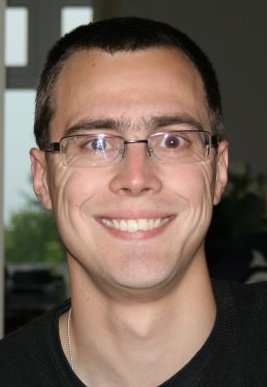
Phil is an X-ray astronomer and leads the University’s involvement in the highly successful Neil Gehrels Swift Observatory. Swift is a highly versatile satellite, originally designed to study Gamma-Ray Bursts (GRBs: the most powerful explosions in the universe) but now used to observe all kinds of transient and variable astronomical phenomena. Phil is particularly interested in time-domain and multi-messenger astronomy (TDAMM); a rapidly-growing field which studies transient events and especially looks to combine “traditional” astronomical data (i.e. light) with other “messengers” that we are now able to detect, such as neutrinos and gravitational waves.
Space Park Perspectives brings together science, society and the humanities to explore how space is shaping life on Earth — and beyond.
To explore Space Park Leicester partnerships, missions, residents, facilities, training programmes and innovation products, visit space-park.co.uk or to learn more about the University of Leicester visit le.ac.uk/.
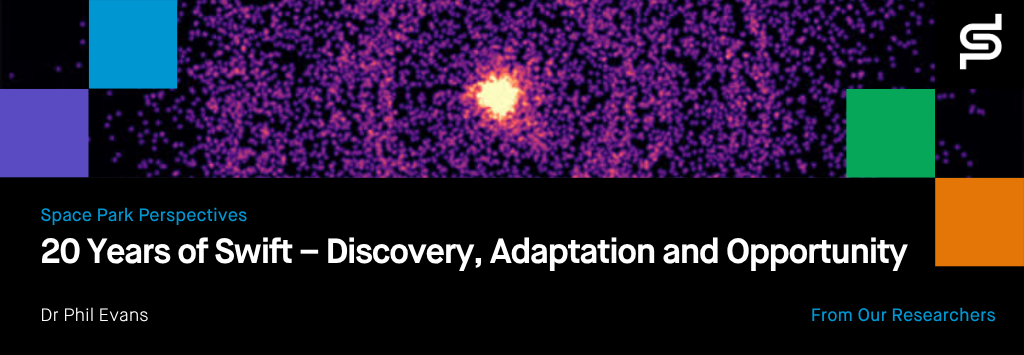
Main image: X-rays from the initial flash of GRB 221009A could be detected for weeks as dust in our galaxy scattered the light back to us. This resulted in the appearance of an extraordinary set of expanding rings. Images captured over 12 days by the X-ray Telescope aboard NASA’s Neil Gehrels Swift Observatory, shown here in arbitrary colors, were combined to make this movie.
Credit: NASA/Swift/A. Beardmore (University of Leicester)